


Green Policy

Germany Reaches Renewable Electricity Milestone

Germany Reaches Renewable Electricity Milestone
Share

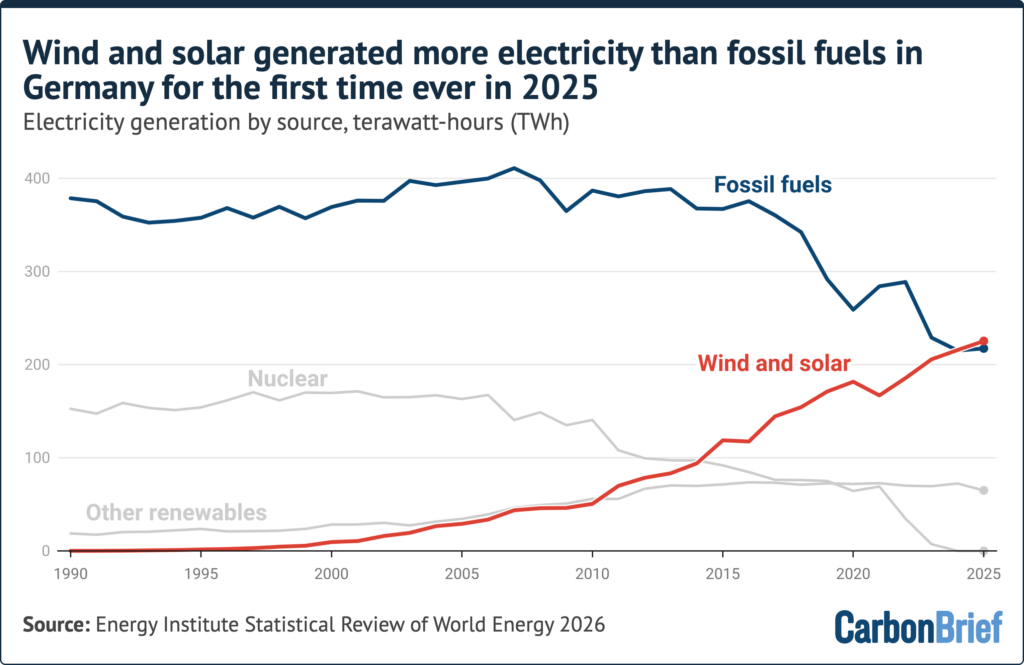
Wind and solar generated more public net electricity in Germany than fossil fuels in 2025 for the first time, according to analysis by the Fraunhofer Institute for Solar Energy Systems. The milestone reflects the rapid expansion of solar power, although Germany still faces challenges involving grid capacity, storage and fossil-fuel back-up.
Wind turbines and solar panels representing Germany’s renewable electricity growth

What changed in Germany’s power mix

Fraunhofer ISE reported that wind remained Germany’s largest source of public net electricity in 2025, while solar generation reached a new high. The comparison concerns electricity supplied to the public grid and should not be confused with the country’s entire energy system, which also includes transport, heating and industrial fuel use.

The result strengthens the case that large electricity systems can accommodate growing shares of variable renewable power. However, weaker wind conditions during the year and increased gas-fired generation also showed why flexible generation, storage and stronger networks remain important.

Lessons for UK energy policy

Germany’s experience is relevant to the UK because both countries are trying to expand renewable generation while maintaining affordability and security of supply. Consistent investment in transmission networks, storage and demand flexibility will be essential as the share of weather-dependent power increases.

The milestone does not mean that Germany has completed its energy transition. Coal and gas still play significant roles, and the country must continue to address network congestion, industrial demand and periods of low renewable output.

Read more about the political risks behind Britain’s power supply.

Read Fraunhofer ISE’s analysis of German electricity generation in 2025.

Share

Editor's Pick

Green Policy

Why Paved Front Gardens Matter for Urban Heat

Front gardens may look like a small part of Britain’s climate debate, but collectively they occupy a large area of urban land. As...

Society

Why Planning Reform Keeps Clashing With Local Control

Planning reform repeatedly returns to the same political problem: Britain needs more homes and infrastructure, but development decisions are made in places where...

Global Affairs

Afghanistan’s Hunger Crisis Deepens as Aid Funding Shrinks

Afghanistan remains one of the world’s most severe food-security emergencies. The World Food Programme says millions of people require urgent food assistance, while...

Voices

How to Read Political News More Critically

Political news is rarely difficult because every report is biased or unreliable. It is difficult because facts, interpretation, selection and emphasis are often...

Economic Affairs

Where Britain’s Green Jobs Are Actually Emerging

Britain’s low-carbon transition is creating new work, but not evenly. Offshore wind, grid upgrades, retrofitting, electric transport and industrial decarbonisation all require workers,...

Society

How Britain Measures Poverty

Arguments about poverty in Britain often sound contradictory because different statistics are answering different questions. A headline may refer to relative low income,...

Related Articles
Weatherwatch: Paving over front gardens is leading to hotter nights
Green Policy

Why Paved Front Gardens Matter for Urban Heat

Front gardens may look like a small part of Britain’s climate debate,...

Energy Security: The Political Risk Behind Britain's Power Supply
Green Policy

Energy Security: The Political Risk Behind Britain’s Power Supply

Energy Security UK remains a fundamental pillar of domestic public policy, shaping...

Carbon Budgets UK and Climate Accountability
Green Policy

How Britain’s Carbon Budgets Hold Governments to Account

Britain’s carbon budgets are designed to turn a distant climate target into...

Air Quality Policy and Urban Public Health
Green Policy

Air Quality Policy and Urban Public Health

Air quality policy is a central public-health responsibility for national and local...